



What the World is Talking About
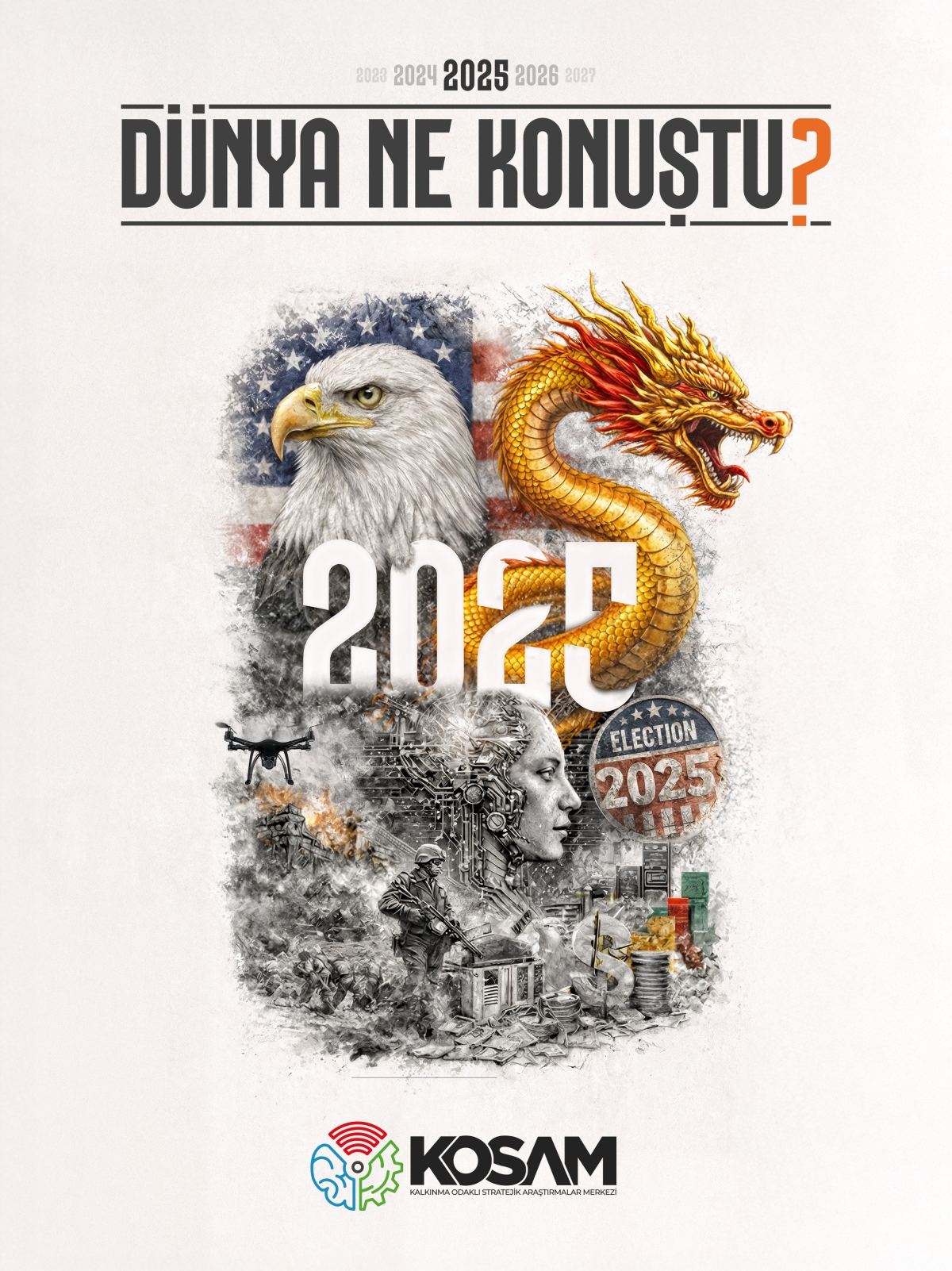
2025 entered the record as a year of “great rupture,” in which long-standing alliances were shelved, economic protectionism was weaponized, and technology crossed boundaries once deemed “impossible.” The global system moved away from the dominance of a single center and evolved into a multipolar and chaotic structure in which each actor deployed its own game plan. Within this turbulent atmosphere, the world economy was constrained to %3.1 growth rate under the pressure of tariffs and geopolitical tensions.
The year’s most disruptive move was the wave of commercial protectionism launched in the United States through Donald Trump’s “Liberation Day” tariffs. Washington confronted not only China but also its closest partners with high duties, while plans to turn Bitcoin into a strategic reserve fundamentally shook the financial paradigm. The U.S. demand for high tariffs even from allied countries weakened cohesion within the G7, while the BRICS+ group positioned itself as an increasingly powerful alternative to the Western-centered financial system. Despite sanctions, Russia sustained its “war economy” model by fully redirecting trade toward Asia and supporting growth through defense spending. Europe and Germany struggled with economic stagnation due to high energy costs, bureaucracy, and structural constraints, yet launched a €500 billion “Defense Renaissance” to strengthen military capacities. China, meanwhile, emerged not only as an economic giant but as a technological “rule-setter.” Through artificial intelligence breakthroughs such as DeepSeek, Beijing challenged Western digital hegemony and began constructing the future across fields ranging from space biology to flying vehicles.
In 2025, the Middle East became the stage for both deepest suffering and tangible hopes for peace. The death toll resulting from Israeli attacks exceeded 66,000, pushing the region to the brink of humanitarian collapse. At the same time, the Sharm el-Sheikh Peace Conference, convened under the leadership of key actors including Türkiye, ignited a faint light after decades of darkness. In Syria, the overthrow of the Assad regime and the reception of Ahmed Shara at the White House redrew the region’s geopolitical map. As nuclear tensions between Israel and Iran brought the world to the edge of a major war, threats to close the Strait of Hormuz pushed global energy security toward paralysis.
Within this complex chessboard, Türkiye consolidated its role as a “strategic balancer.” Its indispensable position within NATO, combined with export success in defense industries stretching from Africa to the Caucasus, transformed the country into a regional power house. At a moment when German panzers stalled and France grappled with a debt crisis, Türkiye emerged as an architect of new-generation warfare doctrines through its UAV and UCAV technologies.
Yet the other side of the coin revealed a world facing chronic hunger affecting 733 million people and resource conflicts triggered by the climate crisis. The struggle for access to critical minerals demonstrated that the “green transition” was not merely an environmental objective but the foundation of a new “military-mineral complex.” As climate change reduced agricultural productivity, the shift toward clean energy fueled a colonial competition over lithium and rare earth elements like “new gold.” With the interruption of Russian gas flows through Ukraine, Europe witnessed the closing of an era in energy security.
In 2025, technology emerged not only as a tool of efficiency but as a “matter of survival.” Artificial intelligence led to large-scale layoffs while simultaneously becoming a core component of intelligence operations and cyber warfare. Debates surrounding autonomous weapons and “killer robots” strained ethical boundaries, while cyberspace turned into a new front where non-state actors and hackers executed billion-dollar operations. China’s advances in humanoid robots, flying vehicles, and space biology reinforced signals that technological supremacy was shifting eastward.
In summary, 2025 was recorded as a year in which the world rapidly moved toward a multipolar order, the logic of “peace through power” prevailed, and technology fundamentally reshaped social structures.
 TR
TR EN
EN